
Drop Forging: The Complete Guide
What is Drop Forging?
Drop forging is a metal manufacturing process that dates back to the industrial revolution. This type of forging involves heating a piece of metal so that it becomes softened. The workpiece is then placed between two dies, and is struck repeatedly using a heavy hammer. During this hammering process, the metal gradually fills out the cavity of the die, so that it takes on a desired shape.
This forging method is able to produce highly complex metal components, and is great for high volume production, as it offers exceptional product repeatability. This forging method is used to create a wide variety of metal products, including eye bolts, connecting rods, valves, and hand tools like hammers and wrenches.
Because of the mechanical properties that the drop forging method imparts on such metal parts, this type of forging is still widely to this day by industries which require complex and high-strength, and durable metal components for a wide range of applications.
Brief History of Drop Forging
Drop forging first emerged in the 19th century during the industrial revolution. It was an evolution of traditional hand forging, which predates written history. The ability to harness steam power in this period meant that forging no longer had to rely on sources of water for power. Steam-powered hammers could now be used to force hot metal into shaped dies, for the production of precise and repeatable metal components.
This mechanised process was then scaled for a wide range of industrial needs, including the building of railways, and the manufacturing of automobiles and hand tools, helping to fuel the industrial revolution. Ultimately, drop forging surpassed traditional blacksmithing as the forging method of choice in his period, preferred for both speed of production and control over precision.
How Drop Forging Works: Step-by-Step Process
Here’s how the drop forging process works here at B.B. Price:
- Pre-heating of the Metal: The process begins with heating a metal billet (often steel or alloys like aluminium) to 1000–1280°C to soften it and make it malleable.
- Metal placed between dies: The heated billet is then placed onto the lower die, which has a cavity shaped like the final part.
- Deformation of the workpiece: Once the metal billet is in place, the upper die, which is attached to the hammer, then drops multiple times, typically 4–5 blows, to force the metal into the die cavity.
- Metal Flows and Takes Shape: Under the high pressure of these blows, the softened metal flows along the die's contours, filling out the cavity to take the shape of the die.
- Trimming: During the hammering process, excess material forms a "flash" or burr along the parting line of the die, which is then trimmed off afterward using a punch press.
- Post-processing: At the final stage of production, shot blasting may be used to remove surface defects from the metal and improve its surface properties.
The result is a highly precise and repeatable metal component, that boasts a range of highly desirable mechanical properties, including high tensile strength, fatigue-resistance, ductility, and durability.
Materials Used
Primary Materials
- Steels: Carbon, alloy, stainless, and tool steels are the most widely used in drop forging, due to their higher tensile strength and cost-effectiveness.
- Aluminum Alloys: Alloys from the 6000 and 7000 series, such as 6061 and 7075, offer excellent strength-to-weight ratios and corrosion resistance.
Other Metals
- Copper Alloys (Brass & Bronze): These metals offer excellent corrosion resistance and conductivity.
- Titanium & Nickel Alloys (Inconel): For high-strength and heat-resistance, titanium and nickel-based alloys like Inconel are often selected.
At B.B. Price, we can recommend specific materials for use in your metal component understand how material choice impacts the quality and longevity of forged components. Our expertise ensures you get the right metal for your project, every time.
Advantages and Limitations
Drop forging is the preferred method of choice for a range of industries for more reasons than just its ability to produce highly complex and repeatable metal components. It is the preferred method because the drop forging process itself imparts certain mechanical properties onto the final product that makes it highly valuable as a manufacturing technique.
During the drop forging process, repeated hammer blows encourages the metal to flow, rather than simplify solidify.
This ensures that the internal grain structure of the material aligns with the shape of the component, resulting in a metal part that boasts a much finer grain structure. This reduces the number of internal voids and defects, enhancing the components’ tensile strength, ductility, fatigue-resistance, and overall durability.
As a result, the metal component is able to withstand higher levels of stress and impact when compared to metal components manufactured via other methods, such as in casting.
In casting, molten metal is poured into molds, and so the metal simply solidifies into shape – it does not flow and produce grain alignment. Cast parts therefore have a weaker internal grain structure. They are more likely to contain voids and defects, and are much more likely to shrink or crack under pressure.
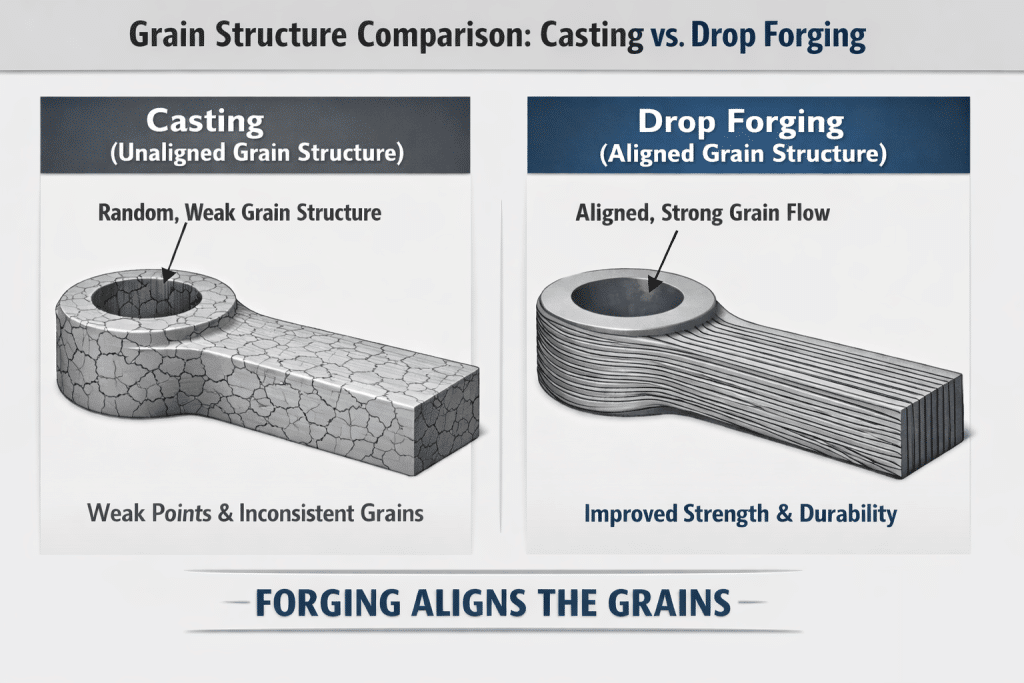
Drop forging is therefore the metal manufacturing method of choice for a range of industries which demand metal components which can withstand high levels of stress and fatigue. Here’s all the key advantages:
Key advantages of Drop Forging:
- Reduced chance of voids
- Superior fatigue-resistance
- Tighter tolerances for enhanced strength
- Excellent surface finish
- Able to produce complex components
- Exceptional consistency and product repeatability
- Improved durability thanks to refined grain structure
- Reduces waste as there is less need for machining
- Cost-effective for high-volume production
- Versatility in the materials that can be used
Ultimately, components made from the drop forging method benefit from superior mechanical properties, as well as enhanced structural integrity.
This makes them ideal for demanding sectors like railway, telecommunications, construction and aerospace, where components need to withstand high levels of stress due to constant exposure to harsh conditions and heavy loads.
However, no manufacturing method is perfect, and so there are some limitations to consider if you are considering choosing drop forging for your production needs:
Limitations of Drop Forging:
- This method may come with higher initial die and tooling costs when compared to casting, as dies will need to be created for each individual product.
- It is not always suitable for very small or highly intricate parts.
- Less cost-effective for small volume production as a result.
- The build up of flash means there may be an additional need for trimming and surface finishing, increasing overall production cost.
- Longer setup time when compared to machining.
- May struggle to produce parts as precise as those made using more modern methods, such as hydraulic press forging.
Despite these drawbacks, drop forging still stands as a cost-effective and highly efficient production method for a wide range of industries, which we’ll discuss in the following section.
Applications Across Industries
Drop forging is prized by industries where high mechanical performance is critical. The high tensile strength, fatigue-resistance, and durability of the parts produced via drop forging lends this process to some of the most demanding industries, where mechanical failure simply isn’t an option.
Here’s some of the industries that benefit most from this forging technique, as well as some of the most typical applications within these industries:
- Rail: B.B. Price are leading suppliers to the UK rail industry, which relies on drop forged steel parts to provide the high strength and fatigue resistance required to withstand heavy loads and vibration under demanding conditions. Products include couplers, brake parts, suspension elements, and track fastenings. under
- Powerline & Telecoms: B.B. Price are principal suppliers to the UK overhead powerline industry, where drop-forged components are used in fittings such as clamps, brackets, clevises, and tension hardware. Forging ensures excellent mechanical strength and durability, which is essential for components exposed to constant tension, weather extremes, and long outdoor service life.
- Construction: In the construction industry, drop-forged components are used in buildings and infrastructure, as these can handle heavy loads over long periods whilst simultaneously resisting impact and environmental damage.
- Aerospace: In aerospace, landing gears and engine components are often made from drop-forged titanium or aluminium alloys. This provides the high strength-to-weight ratios needed for extreme conditions.
- Defence: Forged parts are commonly found in military vehicles and weapon systems. The forging process produces components with superior fatigue resistance and impact toughness, enabling them to withstand extreme shock loads and harsh outdoor environments.
- Industrial Tools: Beyond these, drop forging also plays a key role in the manufacturing of industrial tools and equipment. Hand tools like wrenches and hammers, benefit from the toughness and durability that the forging process provides.
At B.B. Price, we have the expertise to deliver high-quality drop-forged components tailored to the specific demands of your industry, ensuring reliability and long-term performance.
Contact B.B. Price Today
B.B. Price has specialised in drop forging for over a century. Our drop forging facilities are some of the most advanced in the UK, boasting a capacity of up to 1,000 tonnes. We are also able to offer forgings capabilities on steel sections with diameters of 10mm to 50mm.
As principal suppliers to the UK’s overhead powerline and rail industries, our years of expertise has earned us a reputation as Britain’s foremost drop forging company. Get in contact with our team today to discuss your unique project requirements, and find out how a leading UK forgemaster can elevate your next project with quality and precision.
